 English
 عربى
 Español
 中文简体
+86-0572-5888031

0
ENG
Choosing the Best Office Chair for Sciatica: The Specs That Actually Help
 Home / Media / Industry News / Choosing the Best Office Chair for Sciatica: The Specs That Actually Help
Choosing the Best Office Chair for Sciatica: The Specs That Actually Help
 2026.11.14
 Industry News
Content
Most people with sciatica can name the hour their office chair turned on them: the fourth video call, the sharp pull in one buttock on standing up, the leg that stayed heavy for the rest of the afternoon.
By that point the chair has usually been doing three things wrong for months. The seat pan is longer than the thigh, the lumbar pad sits at the belt line instead of the curve above it, and the backrest is locked at one angle because the tension is too stiff to move.
This guide takes the buying decision apart the way a manufacturer would: which numbers belong on a spec sheet, which adjustment ranges are worth paying for, and which parts fail first when a chair is built to hit a price rather than a posture.
What Actually Makes a Chair Work for Sciatica
The best office chair for sciatica is one you can adjust into your own body geometry and then move freely inside, and the thickness of its lumbar pad matters far less than whether that pad sits at the right height.
A sciatica-friendly task chair is a chair whose seat height, seat depth, lumbar height and depth, and backrest tension can each be set independently, so the pelvis stays level, the lower back is supported without being pushed forward, and the front of the thigh is never compressed.
Sitting flexes the hip past ninety degrees in most desk setups, which raises load on the lower discs compared with standing and holds the sciatic pathway under tension from two directions at once: compression at the spine and stretch through the hip and glute. No chair removes that. A good one redistributes it, and lets you redistribute it yourself every half hour.
Four conditions do most of the work. Miss one and the other three stop helping:
- Seat height that leaves both feet flat, with the knees level with or slightly below the hips.
- A seat pan short enough to leave two to three fingers of clearance behind the knee.
- Lumbar support that lands in the small of the back and travels vertically, not only inward.
- A backrest that opens past 100 degrees with tension light enough that you actually use it.
Headrests, mesh patterns and colour are preference. Those four are the purchase order.
The Specifications That Matter
Translate those four conditions into numbers before opening a catalogue, because wording such as ergonomic lumbar support appears on almost every spec sheet and describes almost nothing.
| Specification | Target value | Why it matters |
| Seat height | About 100 mm of travel, typically 400 to 500 mm | Feet must reach the floor without the pelvis tilting back |
| Seat depth | 380 to 480 mm, sliding if possible | A long pan presses behind the knee and lifts the thighs |
| Lumbar travel | 60 to 100 mm vertical, plus depth adjustment | The curve sits at a different height on a 160 cm and a 190 cm user |
| Backrest angle | 95 to 120 degrees with position lock | Locked upright all day is the most common setup error |
| Tilt mechanism | Synchronised, with adjustable tension | Lets the pelvis rotate while the back stays supported |
| Foam and front edge | 45 to 55 kg/m3 moulded foam, waterfall edge | Soft foam bottoms out; a hard edge compresses the thigh |
| Gas spring and base | Class III or IV to DIN 4550, five-leg base | The gas lift is the first part to fail on a low-cost build |
Model note: our ZY6813 pairs a 520 mm seat with a height-adjustable lumbar panel, a configuration we build for buyers who need lumbar travel rather than a fixed pad.
 ZY-6813 Mesh Office Chair with Adjustable Lumbar SupportThe ZY-6813 pairs a 520 mm seat with height-adjustable lumbar support, 3D armrests, and a four-step tilt lock for long work or study sessions.View Product →
Seat Height and Depth in Numbers
Seat depth is the measurement buyers skip and the one most likely to produce that tingling pattern, because a pan longer than the thigh lifts the knees and loads the tissue behind them.
2-3fingers of clearance behind the knee
60-100mm of lumbar height travel to demand
95-120degrees of useful backrest range
20-30minutes between position changes
Seat height then follows the floor. The chart below shows the adjustment range a chair should offer across user heights; a narrower window either leaves tall users riding on the cushion or short users with dangling feet.
Height and depth also interact with the mechanism. A chair that reclines only at the backrest hinge, without a synchronised seat tilt, will slide the lumbar pad upward as you lean back, which is why the spec sheet should name the mechanism type instead of the word reclining.
Depth first, height second. A pan that is too long cannot be rescued by any height setting.
Set Up: Three Zones, in Order
Set the zones in a fixed order and most chairs become usable in under five minutes; adjust them in the wrong order and you will chase the same discomfort through every setting on the chair.
- Depth and height. Slide the seat or raise it until both feet are flat and there are two to three fingers of space behind the knee. If the hips end up higher than the knees, lower the chair and use a footrest.
- Lumbar position. Sit all the way back, then move the panel until it fills the small of the back without pushing you forward. Pressure on the belt line means it is too low; pressure under the shoulder blades means it is too high.
- Recline and arms. Set the backrest to about 100 to 110 degrees, loosen the tension until you can move it with your shoulders, then raise the armrests until the shoulders drop away from the ears.
Change position every 20 to 30 minutes. A chair that holds one posture perfectly still leaves the same tissue loaded, which is why the mechanism matters as much as the cushion: unlock it, lean back, reset, and the load moves without you standing up. For the symptom side of this, our article on office chair selection criteria for sciatica maps settings to patterns.
Mesh, Foam, or Split Seat
Material choice changes how a chair behaves across an eight-hour day more than the name on the base does, and the three common seat constructions fail in different ways.
Mesh back
Best for heat and for people who lean back often. Watch a tightly tensioned mesh that behaves like a board, and a lumbar pad that cannot be moved out of the way.
Moulded foam
Best for spreading pressure under the sit bones. Watch density: below 40 kg/m3 the foam compresses within a year and the front edge starts to bite.
Waterfall or split seat
Best for thigh clearance, because the front section flexes down instead of pressing behind the knee. Needs a real subframe or it sags within months.
Our own back-height-adjustable ZY6815 is a mesh build with a two-dimensional arm option, a configuration buyers request when one chair has to serve users from 160 cm to 190 cm.
 ZY-6815 Mesh Office Chair with Adjustable Back HeightThe ZY-6815 offers adjustable back height, 2D lumbar support, and 2D armrests, making it suited to shared office setups and focused work.View Product →
Ergonomic is not a specification. Ask for the mechanism drawing and the foam density, and the answer tells you within a minute what the chair was designed to do.
Where Buyers Get It Wrong
Four mistakes account for most returns and most of the complaints that arrive six months after delivery.
- Buying lumbar depth instead of lumbar travel. A deep fixed pad pushes the lower back forward and can irritate the same tissue it is meant to protect.
- Ordering a 500 mm seat pan for general use. It fits a tall user and pushes everyone under 175 cm toward the front edge.
- Fixed armrests. If the arms sit too high, the shoulders ride up and the lumbar support stops being used at all.
- Foam density quoted as a range, never tested. Anything under 40 kg/m3 looks fine in a showroom and bottoms out within a year of daily use.
A modest chair that meets the four conditions is a better purchase than an expensive chair with a fixed lumbar curve, because a fixed curve fits one body height and irritates everyone else.
Spec Sheet Checklist for Sourcing
If you are buying for a team or sourcing for resale, put these points into the purchase order rather than the marketing page.
- Adjustment ranges written as numbers in millimetres and degrees, not adjectives.
- Mechanism type plus a cycle test figure for the tilt and the gas lift.
- Foam density, compression set and the front edge construction.
- Gas spring class and supplier, since it is the first part to fail on a low-cost build.
- Certification to EN 1335 or BIFMA X5.1, with ISO 9001 process control behind it.
- A physical sample approved against the spec before mass production starts.
Most of these points are inspection items rather than design features, which is why they belong in the factory conversation. You can read how we run that process in our factory and quality overview.
A lumbar-forward foam seat is the configuration most often specified for users with recent flare-ups: a moulded foam pan with a soft front edge, paired with a mesh back that reclines without losing lumbar contact.
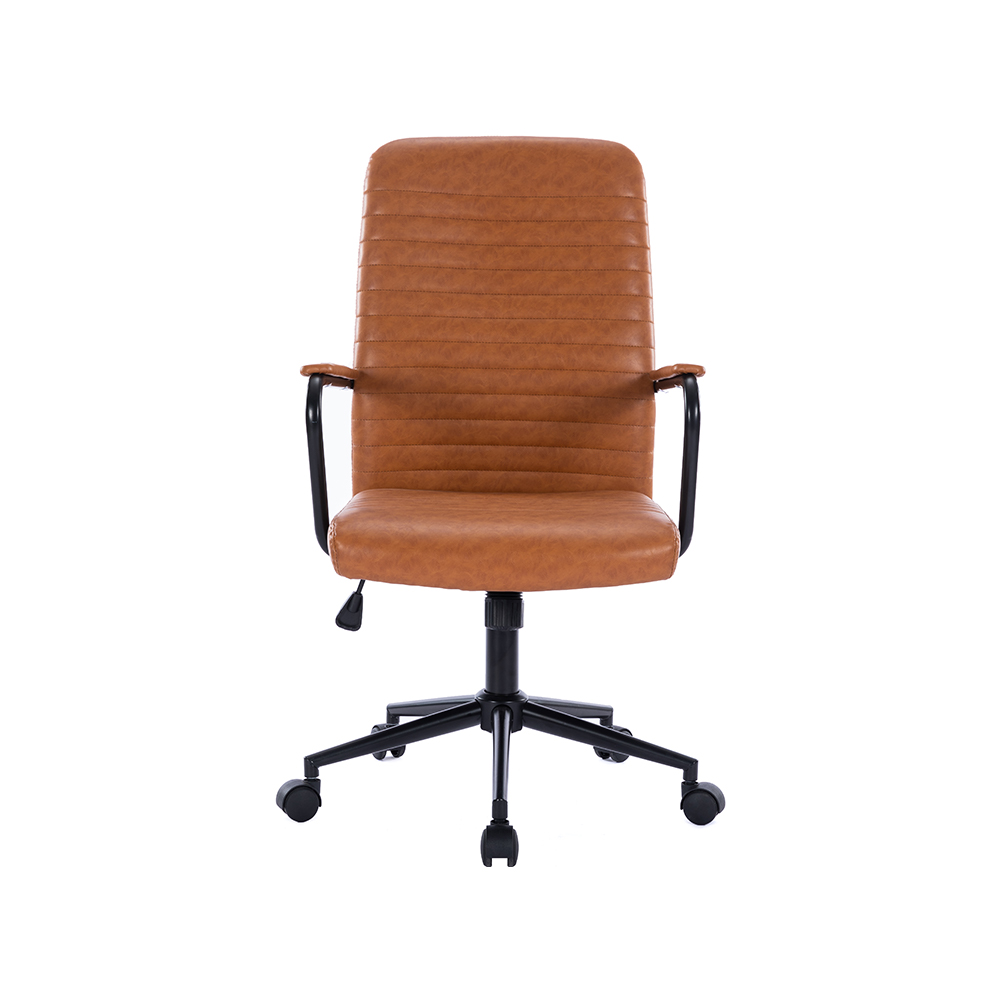 ZY-6034 Foam Lumbar Support Mesh Office ChairThe ZY-6034 combines a mesh back with foam lumbar support and a foam seat, plus rocking and height adjustment for home or corporate desks.View Product →
Frequently Asked Questions
Is a mesh chair or a foam chair better for sciatica?
Neither is inherently better. A foam seat spreads pressure more predictably under the sit bones, while a mesh back keeps the lumbar area cooler and makes recline easier to hold. The deciding factor is adjustability, not material.
Does a lumbar cushion work as well as built-in lumbar support?
A cushion can help for short sessions, but it is fixed in height, usually too thick, and tends to slide as you recline. Built-in support with 60 mm or more of vertical travel fits more bodies and stays where it is set.
How long should I sit before changing position?
Twenty to thirty minutes is a practical interval. The change matters more than the posture: unlocking the tilt and leaning back for a minute moves load off the same tissue without leaving the desk.
What single specification matters most?
Seat depth. If the pan is longer than the thigh, no lumbar setting or recline adjustment fully compensates, and the front edge keeps loading the tissue behind the knee.
This article describes chair geometry for comfort and load distribution. It is not medical advice, and persistent leg pain, numbness or weakness should be assessed by a clinician.
QUICK LINKS
PRODUCTS
CONTACT & INFORMATION
-
 PHONE NUMBER
-
 EMAIL
stellazhang@yimiga.com
-
 ADDRESS
No 366, Jingtu Road, Dipu Street, Anji County, Huzhou City, Zhejiang province, China. PC 313300.
CONNECT WITH US
Be the first to know about our news and updates.


Copyright © Zhejiang Zhongyi Furniture Co., Ltd.
All Rights Reserved.
 浙公网安备33052302000377号
浙ICP备14003933号-2
 Wholesale Ergonomic Chair Manufacturers